
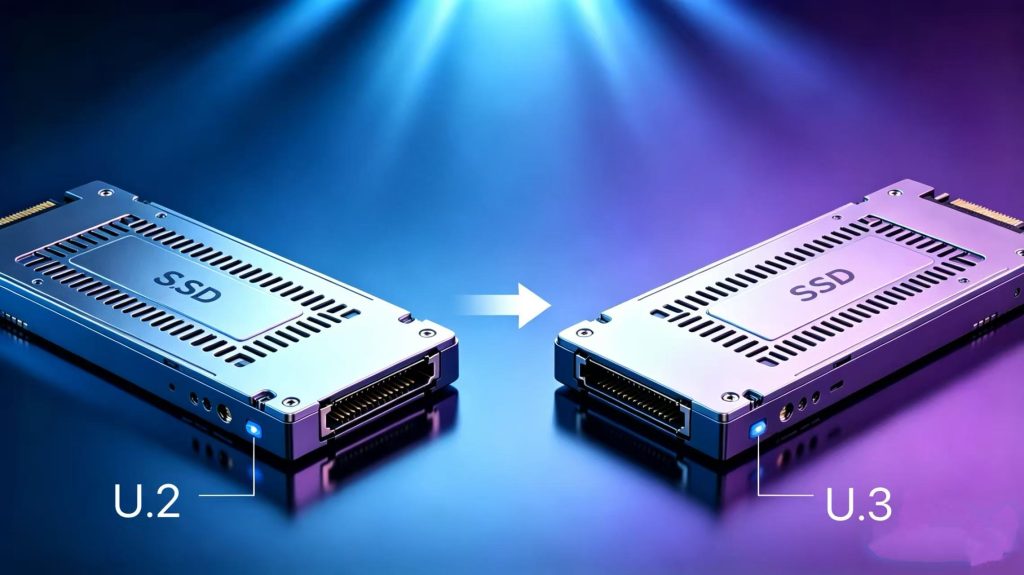
U.2 and U.3 SSDs share the same 2.5-inch SFF-8639 form factor. The main difference is protocol support and architecture, not original speed. U.3 is an enterprise-grade upgrade for flexible mixed drive deployment.
Key Differences
1. Protocol & Architecture
◦ U.2: Supports NVMe, SAS, and SATA but uses separate lanes. It is not mixed insertion on the same backplane in real. It is designed primarily for NVMe.
◦ U.3: Uses redefined pins to let NVMe, SAS, and SATA share lanes. With tri-mode controllers and UBM, it supports automatic mixed use of all three drive types in one slot, simplifying server design.
2. Compatibility
◦ U.3 SSDs: Usually backward-compatible with U.2 slots (NVMe mode only).
◦ U.2 SSDs: Generally not compatible with U.3 slots.
Recommendation
• U.2: Best for personal use or pure NVMe servers — lower cost and more widely available.
• U.3: Ideal for enterprises needing mixed NVMe/SAS/SATA deployments, unified management, and future scalability.
Summary
U.2 is dedicated to high-speed NVMe. U.3 supports true multi-protocol mixing and is the flexible standard for modern data centers.